

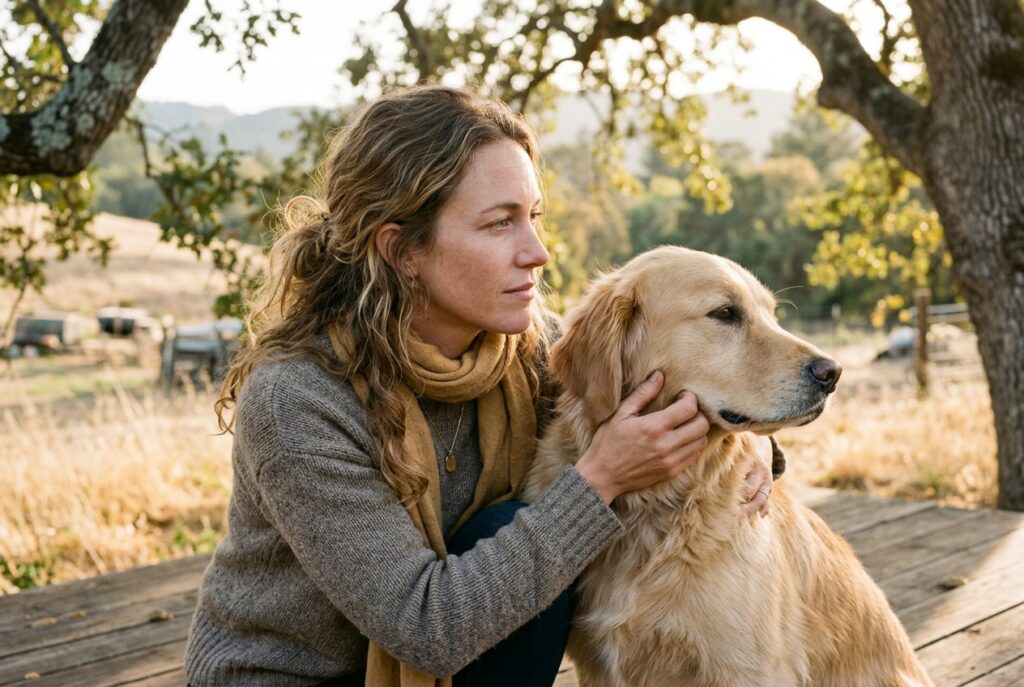
“The way you train your dog is a mirror. Look closely enough, and you’ll see yourself staring back.”
I grew up on a dairy farm in Petaluma, California, surrounded by animals who told the truth in ways humans rarely do. Horses, cows, dogs — none of them will pretend you’re effective when you’re not. They simply respond (or don’t) based on the reality of your leadership. As a little girl, I didn’t know I was learning the most important lessons of my life. I just knew that the animals followed my father’s quiet calm, and scattered when a nervous farmhand raised his voice. In my 25 years of dog training in Petaluma and Sonoma County, I’ve watched those same barnyard truths play out in living rooms across Northern California — and in the hearts of the women holding the leash.
Quick Answer: What Does Your Dog Training Philosophy Say About You?
Your dog training style mirrors your relationship with authority, conflict, and personal power. The four patterns — Pure Positive Parent, Frustrated Commander, Accommodating Enabler, and Calm Consistent Leader — each reveal something real about how you lead in life. Recognizing your pattern is the first step to changing both your dog and yourself.
Decades later, I’ve watched hundreds of women sit across from me, leash in hand, frustrated that their beloved dog won’t listen — and I see the same patterns playing out in living rooms that I once watched play out in the barnyard. What those women often don’t realize is that the way they approach dog training is rarely random. It reflects something deeper: their relationship with authority, their tolerance for conflict, their beliefs about love and control, and their own sense of personal power.
This is not a judgment. It’s an invitation. Because once you understand what your training philosophy says about you, you can change both.
What Does Your Dog Training Philosophy Reveal About You?
Over the years I’ve observed four broad approaches that women tend to bring to dog training. You may recognize yourself in one, or see pieces of yourself in several. Be honest. The dog already knows.

1. The Pure Positive Parent
She believes deeply in kindness. She will not say no, correct, or cause her dog even a moment of discomfort. Every behavior gets rewarded; rules feel like cruelty. The treat bag is always full, but compliance is hit-or-miss — and always dependent on whether the dog feels like cooperating that day.
Her dog knows she’s wonderful. He just doesn’t think she’s in charge.
What it may reflect: Discomfort with conflict. Fear that setting limits means withdrawing love. A belief that being liked and being respected are the same thing.
2. The Frustrated Commander
She wants obedience, and she wants it now. She repeats commands louder when they don’t work — “Sit. SIT. I said SIT!” — and when the dog finally gives up and sits, she calls it a win. She’s not cruel, just reactive. The chaos in her house makes her feel powerless, and she compensates with volume.
What it may reflect: A tendency to confuse forcefulness with authority. Difficulty with follow-through. Frustration that emotional intensity isn’t translating to results — in the dog, or perhaps elsewhere in life.
3. The Accommodating Enabler
Her dog runs the house, and on some level, she knows it. He sleeps in her spot, eats what he wants, goes where he pleases. She apologizes for him constantly — to guests, to strangers on walks, to the vet. She tells herself this is love. But somewhere underneath it, she’s exhausted by the chaos she doesn’t know how to stop.
What it may reflect: A pattern of over-accommodation in relationships. Difficulty claiming space as a leader. An unconscious belief that others’ comfort matters more than her own authority.
4. The Calm, Consistent Leader
She doesn’t yell. She doesn’t beg. She sets clear expectations, follows through without drama, and praises genuinely when earned. Her dog may test boundaries — they all do — but quickly understands the rules are real. The household has a quiet order to it. She’s not the fun one, she’s the trusted one.
What it may reflect: Comfort with her own authority. An ability to hold the line without anger. An understanding that love and structure are not opposites — they are, in fact, partners.
💡 Key Insight: Nature has never used a cookie to convince a lead mare to stay in her role. The herd follows her because they trust her — because she is consistent, calm, and always follows through.
Relationship-Based Dog Training vs. Tool-Based Training: What Nature Actually Teaches Us
I want to address this directly, because the cultural conversation right now pushes heavily in one direction — and the rise of gadget-driven training tools hasn’t made it simpler. Whether it’s a vibration collar or an app-controlled device, the market is full of shortcuts that promise obedience without relationship. Here’s what I’ve learned from 25 years and over 10,000 dogs: the tool is never the answer. The relationship is.
“Positive reinforcement only” sounds compassionate, and there is real value in reward-based training. But here’s what gets left out of that conversation:
Nature is not positive-only. A mother dog corrects her puppies. The lead mare moves an unruly horse out of her space with a decisive turn of her body. There is no cruelty in it — just clear, immediate communication. The correction is forgotten in seconds. The relationship is not damaged. The hierarchy is reaffirmed, and everyone relaxes.
When we remove all consequence from a dog’s world, we don’t make their world kinder. We make it confusing. Dogs are not small humans in fur coats. They are social animals hardwired to seek a leader. When we don’t provide that leadership, they feel compelled to take the job themselves — and most of them don’t want it. A dog who has taken charge of a household is not a happy dog. He is an anxious one.
This is especially true for rescue dogs and rescue puppies. In my work with rescued dogs, I see this anxiety play out in heartbreaking ways — the dog who has never had a consistent leader, who guards obsessively, who can’t settle, who reacts to everything. The key factors in a rescue puppy’s successful transformation are not a better treat or a fancier collar. They are consistency, calm authority, clear structure, and a human who has done the inner work to show up that way every single day. Our Board & Train program in Sonoma County was built specifically to provide that foundation — for the dog and for you.
💡 Key Insight: “The secret I learned from animals is this: a good leader doesn’t demand respect. She simply makes following her feel safer than not following her.” — Camilla Gray-Nelson
What “Follow-Through” Really Means in Dog Training
The most common reason dog training fails is not the technique. It’s not the equipment. It’s not even the dog. It’s follow-through — and follow-through is a character skill, not a training trick.
Follow-through means that when you give a command, something happens whether the dog complies or not. It means your words carry weight because your history proves they do. It means you are calm enough, consistent enough, and confident enough to see a moment through to its conclusion.
Does any of this sound familiar outside the dog context? If you’re curious whether your personal follow-through patterns show up with your dog, this post on why dogs stop listening may give you some useful mirrors.
The women I have worked with over the years who struggle most with follow-through with their dogs often struggle with it in other domains too — setting limits with teenagers, holding boundaries with demanding colleagues, asking for what they need in relationships. The dog is just honest enough to show them. If you’re ready for hands-on support, private dog training in Petaluma gives you that mirror in a structured, supportive setting.
A Gentle Self-Inventory: What Does Your Training Style Say?
Ask yourself honestly:
When you give your dog a command he ignores, what do you do? Do you repeat yourself — louder? Do you let it go? Do you move in calmly and ensure it happens?
Now ask: when someone in your life ignores a boundary you’ve set, what do you do?
Most of us will find the answer is the same in both places. That’s not a coincidence. That’s a doorway. This dynamic is explored further in To Be Loved or To Lead — which is your training goal?
What Is the Quiet Power Principle in Dog Training?
I learned my most important leadership lesson not from a business school or a self-help book, but from watching the lead mare in our herd. She didn’t chase. She didn’t threaten. She simply moved with intention, held her ground without apology, and made it clear — through body language, consistency, and zero emotional drama — that she was the one who set the terms.
The herd trusted her completely. They didn’t love her any less for it. They loved her more, because she kept them safe.
💡 Key Insight: Quiet Power means your dog is not waiting for you to be perfect. He is waiting for you to be decided. The moment you become the calm, consistent leader of your household, everything changes — the pulling stops, the bolting stops, the endless negotiating at the door stops.
This is the model I have tried to bring to dog training for the last three decades, and it’s the model I’ve tried to bring to the broader conversation about women and leadership. Quiet power. Clear limits. Consistent follow-through. No yelling required. No gadget required. Just you — decided, calm, and present.
Your dog is not waiting for you to be perfect. He is waiting for you to be decided. The moment you become the calm, consistent leader of your household — not a dictator, not a pushover, but a trusted authority — everything changes. The pulling stops. The bolting stops. The endless negotiating at the door stops.
And you may find, to your surprise, that a few other things in your life quietly change as well.
Frequently Asked Questions About Dog Training Philosophies
What are the key factors in a rescue puppy’s successful transformation?
In my experience working with thousands of rescue dogs and puppies, the key factors are: a calm, consistent human leader; clear structure from day one; appropriate boundaries delivered without anger; and patience measured in weeks, not days. Rescue puppies often carry anxiety from inconsistent early experiences. What they need most is not more stimulation or more treats — they need to feel, in their bones, that someone reliable is in charge. That safety is what allows transformation to begin. You can read more about how we approach this in our Sonoma County Board & Train program.
Is positive-only dog training effective?
Reward-based training is a genuinely powerful tool, and I use it regularly. But “positive-only” as a rigid philosophy misunderstands how dogs actually experience the world. Dogs live in a social structure that includes both approval and redirection. A mother dog doesn’t ignore unruly behavior — she corrects it swiftly and without drama. The correction passes in seconds; the relationship is not harmed. What damages a dog is chronic harshness, unpredictability, or the complete absence of clear guidance. Balance — warmth and structure together — is what nature models.
What is relationship-based dog training?
Relationship-based dog training means the foundation of everything you do with your dog is trust, communication, and genuine leadership — not equipment, not fear, and not an endless stream of treats. Your dog learns to look to you because you have consistently shown up as calm, clear, and reliable. The training tools you use become secondary to who you are in the relationship. This is the philosophy at the heart of everything we do at Dairydell Canine.
How do I know which dog training approach is right for my dog?
Start by watching your dog, not your training manual. Is your dog anxious, pushy, shut down, or somewhere in between? Each of those signals tells you something about what’s been missing. Then look honestly at your own patterns — are you consistent? Do you follow through? Do you stay calm under pressure? The right training approach fits both of you. If you’re not sure where to start, reach out to us directly — a conversation costs nothing and can change everything.
Does Dairydell offer dog boarding in Petaluma?
Yes. Our dog boarding in Sonoma County is not a kennel in the traditional sense — it’s a structured, calm environment where your dog continues learning even while you’re away. Dogs who board with us come home calmer, not wilder. If you’re in Petaluma or anywhere in Sonoma County and need boarding that reinforces good habits rather than undoing them, we’d love to talk.
Where to Begin — And How Dairydell Can Help
If you recognized yourself in any of these philosophies, start here: pick one behavior your dog does that drives you crazy. Just one. Decide, clearly, what you want instead. Then practice following through — calmly, consistently, every single time — for two weeks. Don’t change twelve things. Change one. Notice what happens.
And notice how it feels to hold that line without losing your cool. That feeling? That’s quiet power. It’s been inside you the whole time. The dog just helped you find it.
When you’re ready to go deeper — when you want a real partner in this work and not just another YouTube tutorial — our Board & Train program is where transformation happens. I’ve seen it with rescue puppies who couldn’t settle, reactive dogs who couldn’t walk on leash, and women who had lost confidence in themselves as much as in their dogs. The work is real. The results are lasting. And it starts with a single decision to show up differently.
Reach out today — I’d love to hear about your dog and talk about what’s possible.
